Tyre service · Dubai, Sharjah, Abu Dhabi
Tyre Pressure Sensor (TPMS) Replacement and Relearn
If your tyre pressure warning light will not go out, a sensor has often failed. We diagnose it, fit and program a replacement and relearn it to the car. Prices start from AED 150 per sensor fitted.
- Scan of all sensors to find the faulty one
- One programmable aftermarket sensor, matched to your car
- Tyre demount and refit with a new valve seal kit
- Programming and relearn so the warning light clears
- Cash
- Card
- tabby
- tamara
About 30–45 minutes for one sensor, about an hour and a half for four
Get my priceHow tpms sensor replacement works
- 1
Scan the sensors
A TPMS tool reads each sensor's ID, battery status and pressure to find the faulty one.
- 2
Choose the sensor
OE or programmable, matched to your car's frequency and protocol.
- 3
Swap the sensor
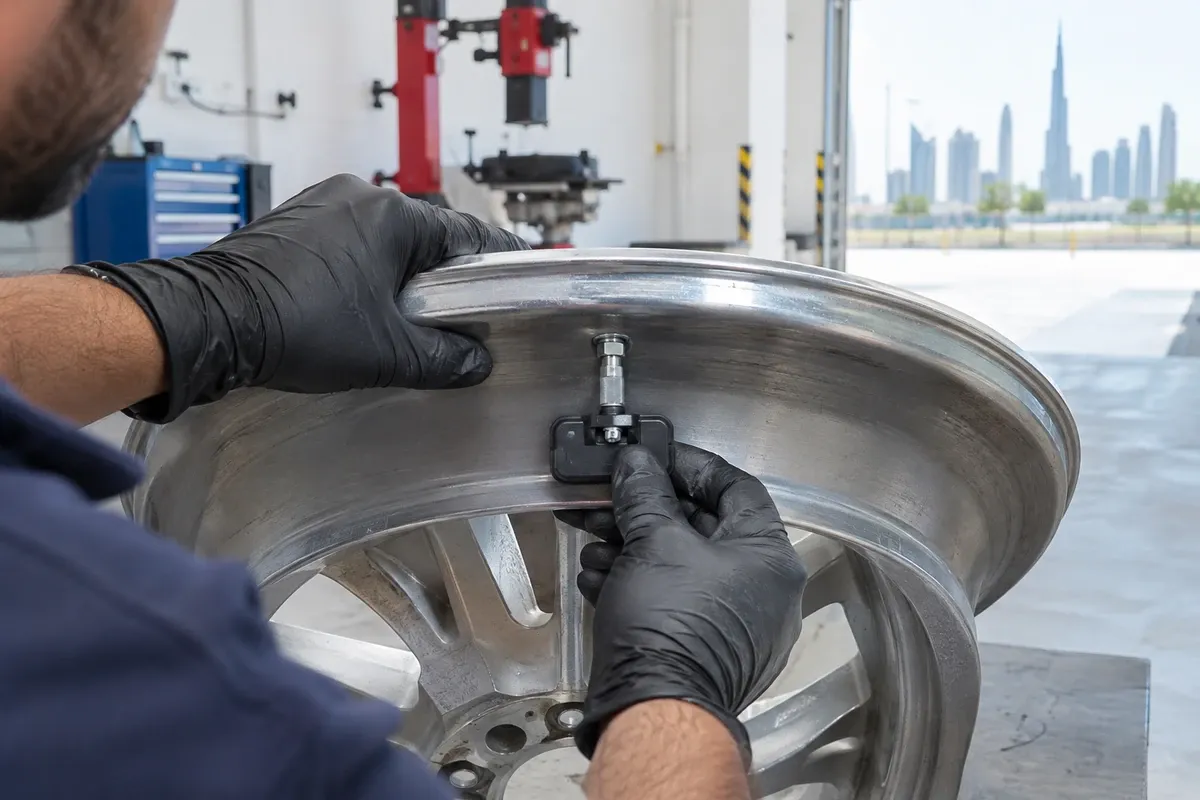
Tyre demounted with the bead kept clear of the sensor, new sensor and valve kit fitted at the correct torque.
- 4
Program and relearn
Sensor programmed, then relearned to the car by the correct method.
- 5
Confirm
Pressures set, warning light checked off, wheel balanced and refitted.
How a tyre pressure sensor works
Most cars sold in the UAE in recent years use direct TPMS: a small battery-powered sensor inside each wheel, usually built into the valve, that reads pressure and temperature and transmits by radio to the car. Some cars use indirect TPMS, which has no sensors in the wheels and instead watches wheel speed through the ABS system; a low tyre turns slightly faster.
Direct TPMS
- Sensor in each wheel, usually on the valve
- Shows actual pressure per tyre on many cars
- Battery sealed inside, lasts about 5–10 years
- Sensor must be replaced when battery dies
Indirect TPMS
- No sensors in the wheels
- Uses ABS wheel-speed signals
- Needs a reset after pressures are set
- Cannot tell you the actual pressure
What the TPMS warning light is telling you
| Light | Usual meaning | What to do |
|---|---|---|
| Solid on | One or more tyres below the threshold, often about 20–25% low | Check pressures cold and inflate; look for a puncture |
| Flashes about a minute, then stays on | System fault: a sensor is dead, missing or not recognised | Have the sensors scanned |
| On after a tyre change | Sensor damaged or not relearned | Relearn or replace the sensor |
| On with spare fitted | Spare has no sensor | Normal until the original wheel is back |
A step-by-step look at the light is in TPMS warning light explained. If the light is solid, start with a tyre pressure check before assuming a sensor is faulty.
Why sensors fail, especially in the UAE
- Battery. Sealed lithium cells last roughly 5 to 10 years. Heat shortens that, so cars in the UAE often see the first sensor fail somewhere in that window, with the others close behind.
- Corroded valve stems. Many sensors use an aluminium clamp-in valve stem with a nut and rubber grommet. Coastal humidity, salty air and fine sand corrode the stem and seize the nut, and the stem can snap during a tyre change.
- Damage during fitting. An inexperienced fitter can break the sensor with the tyre bead. We position the bead away from the sensor when demounting.
- Sealant. Puncture sealant from a repair kit clogs the sensor port.
When tyres are replaced on a car with clamp-in sensors, we recommend a new valve service kit (nut, grommet, core and cap). It is a small cost compared with a sensor that snaps next time.
315 MHz or 433 MHz: matching the sensor to your car
Sensors transmit on one of two frequencies. European, Japanese and Korean cars sold in the GCC mostly use 433 MHz. American-market vehicles such as many Chevrolet, GMC, Ford and Jeep models often use 315 MHz. Imported cars can differ from GCC-spec ones, so we read the existing sensor before choosing a replacement.
| Sensor option | Pros | Cons |
|---|---|---|
| OE (original) sensor | Exact match, no programming doubts | Higher price, may need ordering |
| Programmable aftermarket sensor | Programmed to your car's protocol, usually in stock, lower price | Must be programmed correctly for the exact model |
| Rubber snap-in valve type | Less corrosion, simpler | Not suitable for every car or high-speed use |
| Aluminium clamp-in valve type | Matches many OE designs, looks neat | Needs a service kit and correct torque |
The relearn: why a new sensor alone does not fix the light
Each sensor has an ID, and the car needs to know which IDs belong to it, and on many cars which wheel each one is on. That pairing is the relearn. There are three common methods:
Automatic relearn
The car finds the new sensor itself after a drive of 10–20 minutes above a set speed. Common on many Japanese and Korean cars.
Stationary relearn
The car is put into learn mode and a TPMS tool triggers each sensor in turn.
OBD relearn
The sensor IDs are written into the car through the diagnostic port. Common on some European and American models.
Our technician carries a TPMS tool that reads, programs and relearns sensors, so this is done on the spot, at your home with the mobile tyre service or at a partner centre. After a tyre rotation, cars that show pressure per wheel also need a relearn so the display shows the right corner.
Tyre pressure sensor replacement cost
Replacement starts from AED 150 per sensor fitted, using a programmable sensor. The final price depends on the car, the sensor type and how many you replace. If one sensor has failed from battery age and the others are the same age, replacing all four in one visit saves you three more tyre demounts later. We cover Dubai, Sharjah and Abu Dhabi; the mobile call-out applies if done at your location. See pricing and mobile tyre fitting.
Pricing
TPMS Sensor Replacement price
Not the final price. Your quote depends on tyre size, brand and location and is confirmed before any work starts.
What can change the price
- OE (original manufacturer) sensors instead of programmable ones
- Replacing all four sensors at once
- Cars needing a dealer-level or OBD relearn procedure
- Mobile call-out if done at your location
All prices AED incl. VAT. See every service price or tyre prices by size.
We come to you
Home, office, basement car park or roadside across three emirates.
Price before work
Starting prices online, your full quote on WhatsApp before we start.
Straight answers
If a tyre cannot be saved safely, we show you why instead of patching it.
Pay your way
Cash, card, or split into four with Tabby or Tamara.
Coverage
TPMS Sensor Replacement near you
We bring tpms sensor replacement to homes, offices and roadsides in every community below.
Related services
Tyre Pressure Check
All tyres and the spare checked cold and set to your placard, from AED 20 per car.
View serviceTyre Change
Labour-only tyre change for tyres you supply, at home or at a centre, from AED 35 per tyre.
View serviceTyre Rotation
Tyres moved in the correct pattern for your drivetrain, at home, from AED 40 per car.
View serviceTyre Puncture Repair
Puncture fixed from inside with a plug-patch, at your location, from AED 40 per puncture.
View servicePopular tyre sizes







TPMS Sensor Replacement: questions
How much does a tyre pressure sensor cost in Dubai?
Tyre pressure sensor replacement with mytyres.ae starts from AED 150 per sensor fitted. OE sensors, certain models and a mobile call-out increase the price.
How long does a TPMS sensor battery last?
A TPMS sensor battery typically lasts about 5 to 10 years. The battery is sealed inside, so the whole sensor is replaced when it fails. Heat in the UAE can shorten its life.
Why is my TPMS light flashing?
A flashing TPMS light that then stays on usually means a system fault, such as a dead sensor or one the car does not recognise. A solid light usually means low pressure.
Do new TPMS sensors need programming?
Programmable aftermarket sensors must be programmed for your car and then relearned so the car recognises them. OE sensors also need a relearn.
Can I drive with the TPMS light on?
You can drive carefully to have it checked, but first check all tyre pressures. If a tyre is low, the light is doing its job and the tyre needs attention.
Is TPMS 315 MHz or 433 MHz in the UAE?
Most European, Japanese and Korean cars in the UAE use 433 MHz, while many American-market vehicles use 315 MHz. We read your existing sensor to match it.
Book tpms sensor replacement today
WhatsApp a photo of your tyre or your car model. We reply with a value, mid-range and premium option, fitted where you park.
- Cash
- Card
- tabby
- tamara
Browse tyres and services
Tyre services
Popular tyre sizes
Tyre brands
Tyres by car